
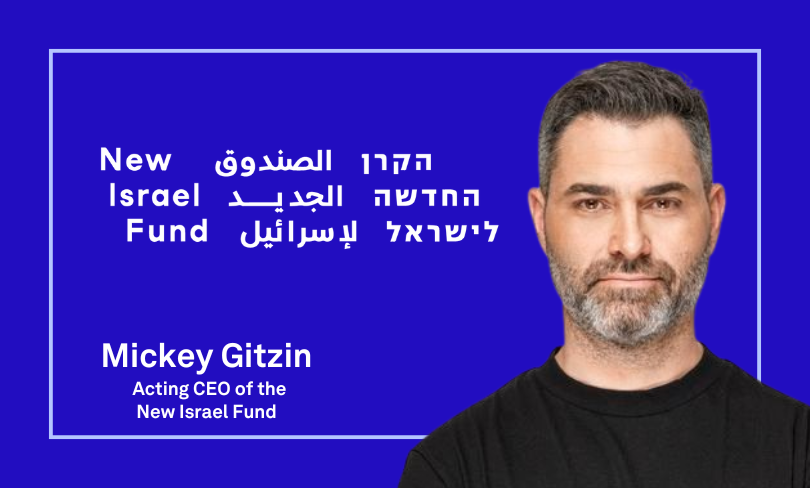
In the months since arriving in the United States, time and time again, I’ve been asked the same question: How is it that you remain hopeful about Israel’s future, despite the daily deluge of bad news?
Last week in Boston, I stood in a room to hear three Israeli protective presence activists, as well as one Palestinian who shared his words via video. As I listened, and as hundreds joined throughout the week in person and online, I realized that here are the seeds of hope. The four leaders shared their experiences working together, side by side, in the West Bank, standing with Palestinians against settler terror. I felt more optimistic than ever.
They spoke about the responsibility to consistently stand in solidarity with those most marginalized. They told us that just a couple of years ago, they were among the few doing this work, and that today there are hundreds of folks interested in joining them. They passionately argued that the norm is changing: that what was once willful disregard for Jewish terrorism is now giving way. A new willingness to reckon, head on, with brutal settler attacks is beginning to replace that apathy.
Late last week, the Israeli government took another step toward funding Jewish settlement in the West Bank. A couple of days later, the IDF, too, proceeded with legalizing farms owned by Jewish settlers in the West Bank. Last week, a Palestinian man with disabilities was wounded at such a farm.
But that’s exactly why the delegation of protective presence activists was so inspiring. Protective presence isn’t only the right thing to do: to stand in solidarity with those discriminated against, targeted, and terrorized. No, protective presence is not just a moral imperative.
It is also a political responsibility. It is the best way for us to challenge, head on, the rising violence, total impunity, and breakdown of the rule of law, to defend democracy, justice, and equality.
And it is effective. It’s a humble action: to simply be present, to resist violence by standing tall. It is not flashy or fancy, and it’s sometimes dangerous. But protective presence addresses reality as it is; it sits with the discomfort and unpleasantness, unwilling to relent on what is right and just.
This movement, this growing grassroots effort to stop settler violence and its state sponsorship, must be our map forward. Protective presence is consistent, it’s uncompromising, and it’s communal. Activists show up day in and day out without drawing headlines and cameras, without winning awards. Focusing on what’s happening on the ground, in the West Bank, is the best way to put an end to Jewish terrorism and the government policy behind it.
And we, too, are behind them. Last month, the New Israel Fund held a meeting with new donors in Israel to establish the Headquarters for Combating Annexation and Settler Violence. Previously uninvolved in NIF, these new leaders were briefed by former Shin Bet Director Ami Ayalon and Israeli lawyer Michael Sfard. These forty philanthropists saw how urgently we need to shut down both the explosive violence and the Israeli government’s backing of creeping land grabs in the West Bank. That’s why they are stepping up and making substantial commitments to fund this work.
On the public relations side, a campaign launched last week by Israeli civil society organizations aims to raise awareness among Israelis. It explains how the mechanism of Jewish terrorism in the West Bank works, while also recruiting Israelis to participate in protective presence. It powerfully calls on Israelis of all stripes to wake up: “Do not stand aside while everything burns.”
That’s exactly what inspires me. And what supercharges that motivation is seeing how devoted the North American Jewish community is to hearing these very stories and amplifying their impact. Hundreds of participants joined us at each location, including representatives from mainstream Jewish communal organizations. You, too, can watch last week’s event.
But hundreds aren’t enough. We know that the consensus is on our side, that violence and terrorism are absolute red lines for our communities, regardless of political or religious views. We will continue to demand an end to these unacceptable attacks by continuing to grow protective presence activism among Israelis and Palestinians. What we now need is your steadfast support here in North America to grow our community of leaders, institutions, and activists saying no to the dispossession of Palestinian communities, no to Jewish terrorism, and no to more bloodshed. Together, we can turn the tide: from apathy to moral conviction, from despair to determination, and from bystanders to a movement too large to ignore.