
Two weeks ago, Alex Sinclair, a lecturer at the Hebrew University of Jerusalem, was detained by the police and thrown into jail. His crime? Publicly expressing his vision for a better, more peaceful future for all Israelis and Palestinians.
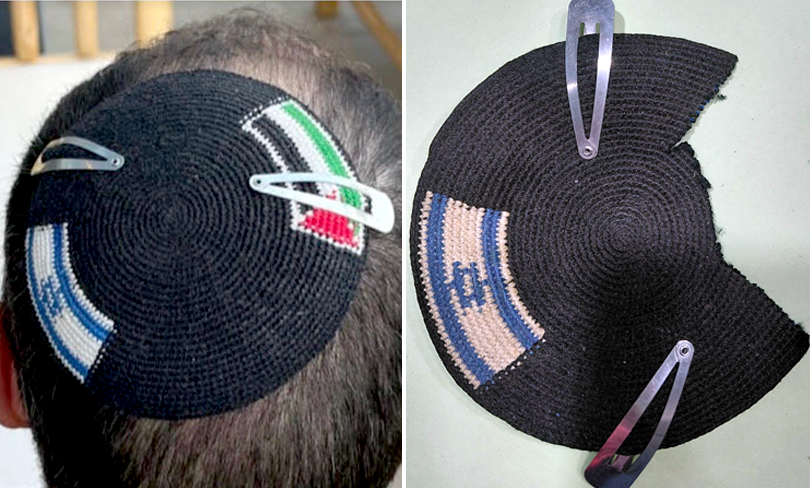
He did this by walking out of his home wearing a kippah depicting both an Israeli and a Palestinian flag.
The ability to express political views openly, publicly, and without fear of persecution or reprisal is a fundamental right in any democratic society. But on Minister of National Security Itamar Ben Gvir’s watch, Israeli police are working hard to erode this right.
As Alex sat in a cafe in Modi’in working on his laptop, he was approached by police who told him, incorrectly, that wearing such a symbol is against the law. The officers took him into custody, confiscated his belongings (including the kippah), and locked him in a cell. Alex was not even allowed to make a phone call.
When he was finally released and the kippah returned to him (at his insistence), it had a large patch cut out where the Palestinian flag had once been. The officers were apparently so offended by the idea of Israelis and Palestinians existing side-by-side that they were willing to take a pair of scissors to a religious object.
Alex knew something had to be done. He reached out to his network through a WhatsApp group and immediately heard back from NIF’s Director in Israel, Shira Ben Sasson. Shira put Alex in contact with NIF’s Civil Society Protection Hub, an NIFC partner. The Hub connected him to a lawyer and helped him file an official complaint.
“They’ve been amazing. I couldn’t have handled this situation without them,” Alex said. “I felt protected.”
It is for situations exactly like this that NIF created the Hub: to provide resources to those in Israel who are targeted for exercising their fundamental civil rights. Freedom of speech not only allows for dissent but creates the opportunity for political imagination: for anyone to envision, and work towards, a more just future. That’s why authoritarian leaders work so hard to curtail it. That’s why NIFC will not—cannot—stop investing in its protection.
Freedom of speech can be loud. It can be protests in the streets, mass mobilization, and calls to get out the vote. But it can also take the shape of a message on a kippah, worn despite growing repression, that insists that all people be treated as equals.